SIL 3 Safety Sensor — Module and System Test with Coverage Evidence
Individual modules and the full assembly tested with two coordinated counterparts, sensor data injected in real time, and code coverage captured over the trace port.
Industry: Manufacturer of safety sensors for robotics and industrial automation (functional safety, SIL 3).
The challenge
The sensor consists of six individual boards connected in a daisy chain via high-speed connectors. Each module carries two cores and the modules communicate over a fast inter-processor link. Fully populated, the system processes radar and thermal data (inputs via LVDS and SPI sensors).
- As a SIL 3 project, both the individual modules (drivers, protocol) and the full system must be tested completely and reproducibly.
- The safe output signals (OSSD A/B) must react correctly under realistic scenarios.
- Test coverage has to be demonstrated from the firmware.
The LoopCheck solution
Two coordinated LoopCheck boards cover both test levels — one for the single module, one for the full assembly. Each element is tested first in isolation and then in the complete network.
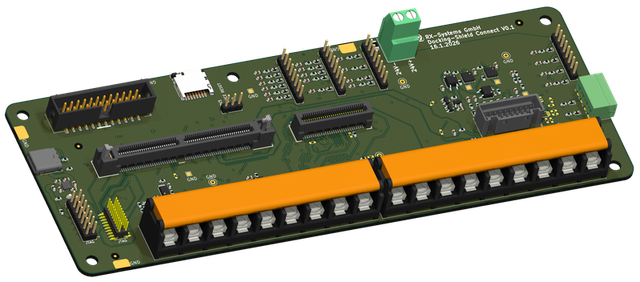
- Single-module test — drivers and protocol per module in isolation; a fault is attributed unambiguously to its module rather than searched for in the whole system.
- Full-system test — the complete daisy chain, with radar, thermal and camera data injected in real time for realistic scenarios including edge cases.
- Safe outputs — the switching behavior of OSSD A/B is evaluated; plus Ethernet communication and firmware flashing.
- Evidence — code coverage is captured during the tests over the trace port.
Two levels, with proof instead of estimate
Testing on both the module and the system level, reproducibly and with demonstrable coverage: faults are localized precisely at the module level, realistic scenarios are driven by real-time data injection, and the OSSD outputs plus trace-port coverage form the basis for the SIL 3 case.
Result
-
SIL 3
Functional safety with demonstrated test coverage.
-
Two levels
Single module and full system tested separately.
-
Coverage
Code coverage evidenced over the trace port.
Related: Safety-critical systems · Adapting to a new DUT · All reference projects